The Silence in the Canyon
How far would you go to find someone you love?
Gabriel N Elizondo
December 11, 2025

Exploring the intersection of reality and fiction.
How far would you go to find someone you love?
Gabriel N Elizondo
December 11, 2025
An empty seat at the table, a quiet bedroom, a vacant bedside, an overwhelming silence. How far would you go to find someone you love? The partner who didn’t come home one night. The child that doesn’t get off the bus. The sibling who vanished without a trace. What would you do when the police give up? When the media refuses to cover the disappearance because no one cares about your people? What then?
In the historical fiction novel, Feed the Gods, a peaceful 16th century healer tribe, the Rarámuri, suffers a devastating loss when one of their own goes missing beyond their territories. When the younger brother of the vanished member returns from gathering sacred medicines, he stops everything to find her. Beyond the safety of the world he’s known, the horizon holds more than harsh terrain. Among the sagebrush and mile-deep cliffs, a steel covered army makes their way towards his home.
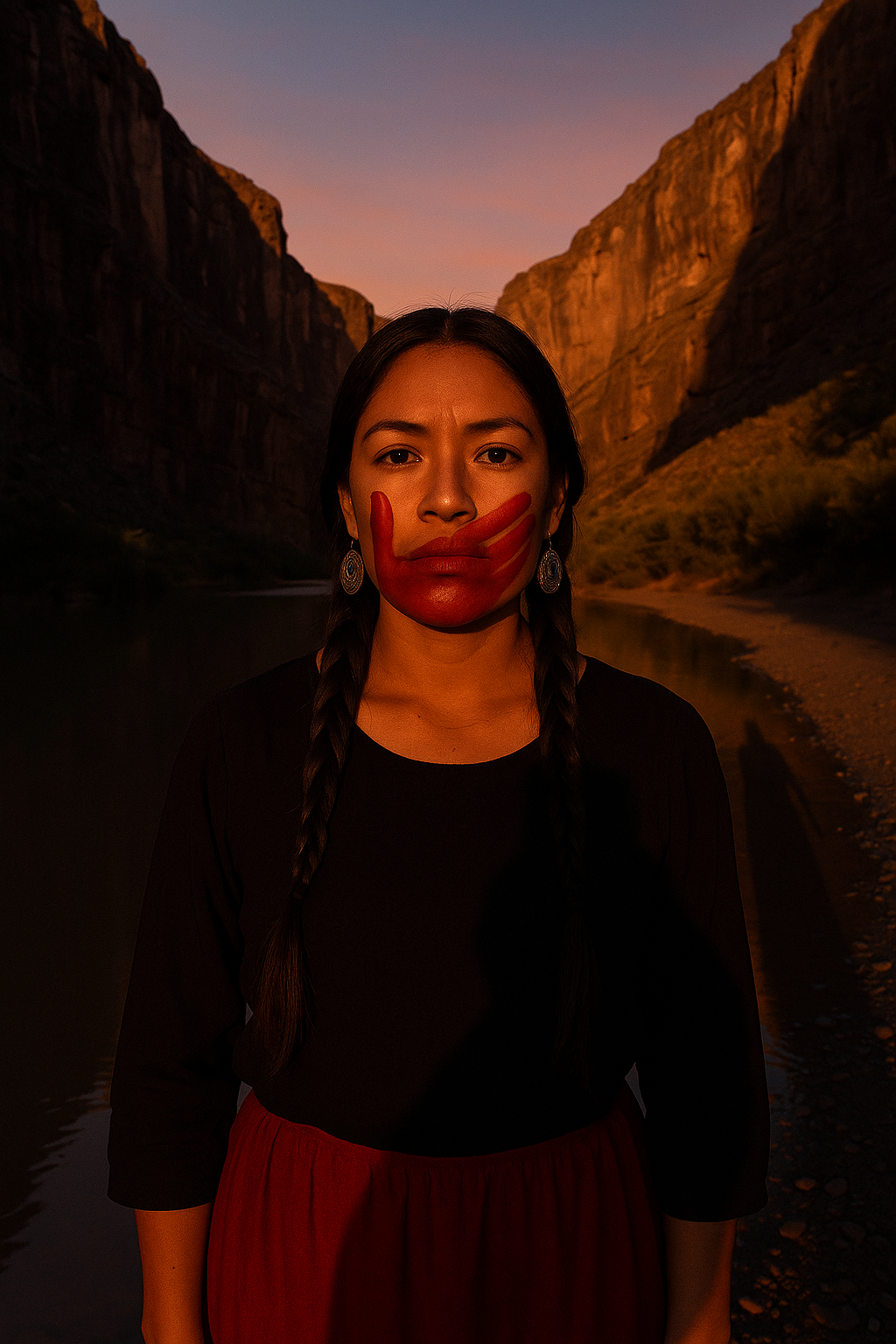
Feed the Gods is fiction, a historically rich exploration of conquest and resistance. Yet, for millions of indigenous families, Moró’s literary suffering is their real life nightmare.
Five-hundred years after the arrival of European colonizers, indigenous populations are still being treated as commodities, abducted, tortured, and murdered by colonizer forces with near immunity. This government-sponsored mechanized system of erasure enables colonizers to avoid accountability and justice on behalf of former empires, now, nations of the Americas.
The Rarámuri of northern Mexico are still contending with outside invaders looking to exploit and enslave for profit. Drug cartels like the Sinaloa Cartel are prevalent throughout the Sierra Madre region, forcing Rarámuri tribes to harvest poppy fields for processing into drugs. Families within the tribes face horrendous violence, oppression, and terror if they refuse to comply. The largest consumer of these illegal drugs is the American colonizer just north of the border. At the same time, the very weapons used by cartels are supplied by the American colonizer. This narcotic-industrial complex allows colonizing forces, such as the American government, to maintain a cyclical relationship of drug-consumption and weapons distribution across international borders. Racist laws enable the direct-oppression of indigenous populations within the United States border by American forces. The most openly hostile of these forces is the United States Immigration and Customs Enforcement Agency also known as ICE.
American colonizer governments have created a detailed system of oppression that leverages American institutions to enforce terror, slavery, and genocide on the indigenous people within the nations borders. The Department of Homeland Security, and their terrorist branch known as ICE, has led a direct campaign of violence against indigenous peoples since its inception. In the most recent years, the agency has become more brazen with its ultimate goal of genocide.
In 2024, the Department of Homeland Security Office of Inspector General (OIG) reported that ICE failed to effectively monitor the location of countless unaccompanied migrant children after their release to sponsors or transfer to the Department of Health and Human Services (HHS). More than 32,000 children failed to appear for their immigration court hearings between FY 2019 and FY 2023, and ICE was unaware of their whereabouts. The OIG report suggested the number could be much higher, potentially up to 323,000 children, as ICE failed to issue formal Notices to Appear (NTAs) for over 291,000 children, meaning they were never entered into the formal tracking system for court dates.
As of September 2025, ICE has been directly responsible for more than 25 deaths due to neglect, abuse, or murder. Following an operation in Chicago nicknamed "Midway Blitz," human rights attorneys reported that the whereabouts of over 3,000 arrested immigrants were unknown. Additionally, over 1,200 people were reported missing from the Everglades detention facility ("Alligator Alcatraz") as families and lawyers were unable to locate them.
Every number is a human being whose life was stolen at the hands of a colonizer. Every number is a family who lives a nightmare, unable to find closure or justice. It’s easy to pass over these massive numbers without empathy for each figure. That ease in which thousands of lives are dismissed as statistics is not an accident. It is a carefully curated response by colonizer governments that allows them to get away with murder and genocide. This practice is rooted in imperial tradition and has infiltrated modern culture with the ease of a marketing campaign.
In Feed the Gods, Spanish colonizers genocide hundreds of thousands of indigenous tribes, enslaving victims via encomiendas to extract mineral wealth from stolen land. Royal decrees and religious oaths attempt to shape European greed into a pious mission of salvation. Yet, the ramifications of this state-sponsored terror can be seen in the modern day enslavement of indigenous tribes to farm and traffic drugs instead of mine silver on stolen land.
For centuries, colonizer disease, genocide, and the curated narratives that followed, erased entire populations of indigenous tribes. Modern national cultures fail to accurately represent indigenous people, the injustice brought on by their European and American colonizers, and the dehumanization of victims by national governments. This proactive effort to effectively remove centuries of violence and genocide creates a colonizer-centric narrative that stands proudly on the graves of millions.
According to Andrés Reséndez, a professor at the University of California, Davis in his book The Other Slavery, 2.5 to 5 million Indigenous people across the Americas have been enslaved from the arrival of Columbus to the 20th century. Captured family members vanished in Spanish wrought iron cages, Mexican silver mines, settler ranches, and cotton plantations.
In the early years of the United States land theft, the American government broke treaties, forced pacts, and created racist laws that removed the sovereignty of North American tribes. A few miles north, mid-western and Canadian boarding schools systematically removed indigenous children from their homes. The 2022 Federal Indian Boarding School Initiative investigation found 53 confirmed burial sites and over 500 student deaths, with the Department of the Interior projecting that number to rise into the thousands. More stolen children. More vanished family members. More indifferent silence.
Since the arrival of Europeans along the shores of indigenous lands, the dehumanization of indigenous peoples has been a carefully orchestrated effort to extract resources from both the land and the people. This history of exploitation and death created a national culture that accepts the dehumanization of indigenous people. Patriarchal imperialism removed the sanctity and authority given to women within indigenous cultures and replaced it with objectification and abuse by European and American colonizers at large.
National, local, and tribal governments constructed on patriarchal systems further removed the considerations of resources to help protect, advocate, and locate missing indigenous women. The Major Crimes Act of 1885 in the United States continued to strip tribal sovereignty by removing jurisdiction from tribal authorities in the investigation of major crimes. This law granted Federal authority over tribal lands, reducing the ability for indigenous tribes to allocate resources in the investigation of major crimes against their own people on their own land.
Ninety-three years later, the American colonizer government solidified its position as an oppressing force against the indigenous population with Oliphant v. Suquamish Indian Tribe. This ruling stripped all tribal governments from prosecuting “non-indians” involved in major crimes against indigenous people. This legalized difference in human beings codified the lack of value the American colonizer has for the indigenous victims on their own land.
According to the NCIC (National Crime Information Center) data, there were 5,295 reports of missing American Indian and Alaska Native women and girls in 2020 alone. And the UIHI (Urban Indian Health Institute) found that 153 cases were not even in law enforcement records at all in just one study of 71 cities. In each of these cases, there are family, friends, and community members who refuse to give up the value of their missing loved ones, especially in the face of colonizer governments.
A carefully constructed lack of representation and cultural erasure makes it easier to ignore those who vanish at the hands of colonizer governments. Colonizers’ laws and government bodies defined and devalued the worth of human life based on racist, imperial practices that only serve elite, wealthy men.
This lack of representation not only removes the presence and relevance of indigenous populations and their impact on society, but further removes the awareness of society in general, eliminating the accountability colonizers might face by the public. One cannot find those who are never considered to exist in colonizer-society as colonizer authorities work to cover their failures, time and time again.
When someone goes missing, the psychological and emotional trauma does not stop until they are found. The ambiguity of loss is exponentially magnified in the absence of that person, leading the individual(s) grieving in a state of perpetual anxiety. This mixture of emotions, and the physical exhaustion that is brought on by it, leads the individual to face a psychological torment that is ongoing.
As Moro realizes the severity of his sister’s absence he reaches out to his tribe for help. However, the tribal leadership ignores his requests, dismissing his concern and prioritizing tribal laws and traditions over his loss. Infuriated, Moro returns to his own efforts, refusing to abide by tribal authorities and breaking every rule to find his sister. He faces off against the elements of his environment, hostile foes, dismissive authorities, and his own emotional battles to keep going. There is no option to go home, for Moro, his sister is worth everything, including his life.
For the missing indigenous, for the slain victims at the hands of colonizer greed, for the modern struggle in human rights, and for the future of all indigenous tribes, there is no option but to keep searching until everyone of us comes home.
Sign up to receive updates on new content and future events.


